
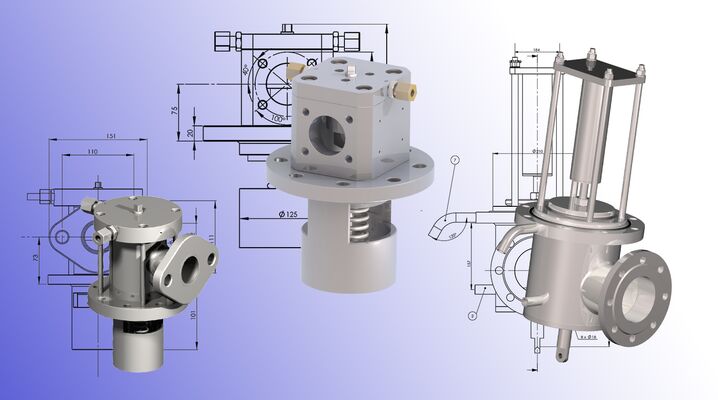
Hazardous Goods Transport - Valves on Rail
For more than 30 years, VENTAIX has been developing and manufacturing valves for the safe transport of hazardous goods by rail - from hydraulically driven forced ventilation valves and bottom discharge valves to the screw cap seal. All components are subject to strict safety monitoring and quality control while retaining a simple, maintenance-friendly design.
Highest Safety Requirements in Hazardous Goods Transport
The transport of liquid hazardous goods is characterised by a particularly high degree of safety and reliability. All modules and components belonging to the "hazardous goods transport" process chain are therefore subject to strict safety monitoring and quality control. The valves we have been developing and manufacturing for this sensitive field for more than 30 years are accordingly distinguished by their safe and reliable function over long periods. In all our developments we place particular emphasis not only on safety aspects but also on a simple, maintenance-friendly design – because only a valve that can be checked and serviced easily in operation can reliably fulfil its safety function throughout the entire service life of the rail tank car.
Forced Ventilation Valves: Hydraulically Driven, Safely Accessible
One focus of our developments to date is the hydraulically driven ventilation valves on rail tank cars. These forced ventilation valves are required in order to vent or aerate a tank during loading and unloading. As such valves are located on the crown of the tank, they are generally difficult to access and are preferably operated from the position where the filling and discharge connections are also located.
The hydraulic drive for the ventilation valve offers many advantages. High opening forces can be applied regardless of weather conditions, without bending any linkages or damaging other actuating elements. Especially at winter temperatures or after long periods of standstill, when valves can tend to stick, the advantage of a powerful, weather-independent drive becomes particularly clear.
Furthermore, there are no internal fittings of the actuating device inside the tank that could interfere during a necessary cleaning of the tank interior or even be damaged – an aspect that considerably simplifies cleaning and maintenance of the tank. Our forced ventilation valve is available in the standard nominal sizes DN80 and DN40.
A Consistent Programme for the Rail Tank Car
In addition to forced ventilation valves, we also develop and manufacture other components for rail tank cars. The focus here is on both hydraulically and mechanically driven components, so that the appropriate drive type can be selected for different requirements and operating conditions.
From the forced ventilation valve and the matching position indicator through to the bottom discharge valve, we offer you a coordinated range of valves – simplifying spare parts management and maintenance across the entire rail tank car instead of having to combine components from different manufacturers.
Individual Advice and Custom Solutions
We not only offer you our existing valves but are also glad to advise you when it comes to planning special valves for your application. Should the standard versions not match your specific requirements in terms of nominal size, connection or installation situation, we will develop a precisely fitting solution together with you – get in touch with us.
Get in touch now!
Frequently Asked Questions about Valves for Hazardous Goods Transport
Which valves does VENTAIX offer for hazardous goods transport?
From forced ventilation valves and bottom discharge valves through angle seat valves and vane cell dampers to the screw cap seal and matching accessories, VENTAIX has been developing and manufacturing valves for rail tank cars for more than 30 years.
Why are the ventilation valves hydraulically driven?
The hydraulic drive delivers high opening forces regardless of weather conditions, without bending linkages or damaging other actuating elements.