
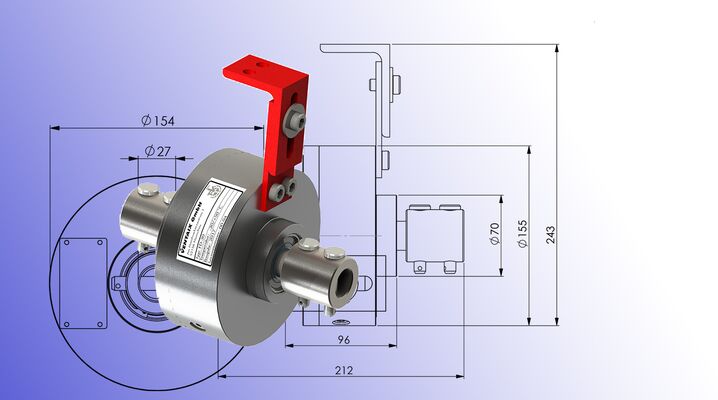
Vane Cell Damper FD-30
Mechanical bottom discharge valves on rail tank cars snap back sharply when closing due to the force of the valve spring - a considerable risk of injury for operating personnel. The vane cell damper FD-30, developed jointly with Franz Kaminski Waggonbau GmbH, damps only the closing movement and thus closes a safety gap without impairing the opening operation. Easy retrofitting on any existing operating linkage.
The mechanical bottom discharge valves of a rail tank car are opened by means of a linkage operated by a lever on one of the two sides of the car. The lever is usually turned through 120°. The spring force of the bottom discharge valve, which acts in the closing direction, requires a correspondingly high torque to move the lever. In its end position the operating lever is locked.
After loading or unloading, the bottom discharge valve has to be closed again. To do so, the lever is unlocked and the entire restoring torque acts immediately on the hand lever. Depending on the size of the bottom discharge valve and the strength of the valve spring, this results in a powerful kickback which the operator has to absorb manually. This process can cause considerable injuries to the operator as well as damage to the valve seat and the bearings in the operating linkage.
Operating Principle
The vane cell damper FD-30 was developed jointly by Franz Kaminski Waggonbau GmbH and VENTAIX GmbH in order to eliminate these hazards and to close bottom discharge valves on rail tank cars safely and in a controlled manner. The particular characteristic of the vane cell damper is that only the closing movement is damped, while operating the lever to open the valve remains undamped.
The damping is produced by the fluid inside the vane cell damper. The higher the restoring torque, the greater the damping of the rotary movement of the hand lever. In this way the closing operation of the mechanical bottom discharge valve loses its dangerous and damaging effect, both for the operator and for the closing mechanism of the rail tank car.
Installation
Installing the vane cell damper is extremely straightforward and can be carried out on the existing operating linkage of any rail tank car. All that is required is to separate the existing handwheel shaft at a suitable position, remove a section of the shaft and fit the vane cell damper into the resulting gap using shaft adapters. The adjustable mounting bracket allows the vane cell damper to be fixed at a suitable point on the rail tank car.
The vane cell damper FD-30 closes a safety gap.
- Safe and controlled closing movement
- No kickback of the operating lever
- No injuries to operating personnel
- No wear on the valve seat
- No wear on the linkage bearings
- Simple retrofitting on the existing linkage
Download
Frequently Asked Questions about the Vane Cell Damper FD-30
Which problem does the vane cell damper FD-30 solve?
When mechanical bottom discharge valves are closed, the spring force of the valve causes the operating lever to snap back sharply, and the operator has to absorb this manually – which can result in considerable injuries and damage to the valve seat and the operating linkage. The FD-30 damps this closing movement in a controlled manner.
Is the opening of the bottom discharge valve damped as well?
No, only the closing movement is damped. Operating the lever to open the valve remains undamped.
How complex is the installation of the FD-30?
Installation is simple and possible on any existing operating linkage: the handwheel shaft is separated at a suitable position, a section of the shaft is removed and the FD-30 is fitted into the resulting gap using shaft adapters. An adjustable mounting bracket allows the damper to be fixed at a suitable point on the rail tank car.