
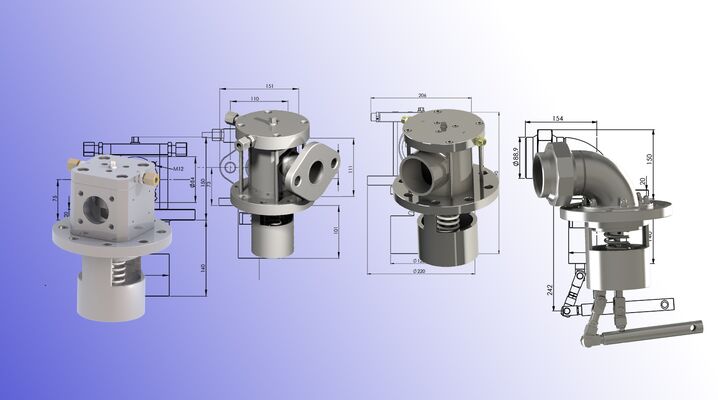
Forced Ventilation Valves
Forced ventilation valves ensure controlled pressure equalisation on rail tank cars and tank containers during the loading and unloading of hazardous goods. VENTAIX supplies these valves in 4 model variants (ZB2-100, ZB3-65, ZB4-100, ZB5-100) for use in tanks transporting hazardous goods by rail and road.
Forced Ventilation Valves for Safe Hazardous Goods Transport
Pressure equalisation is essential for the safe emptying and loading of tanks and vessels. Unvented containers represent an enormous accident risk for operating personnel, the environment and property (example of an unvented rail tank car). Ventilation valves therefore play a central role in the safety concept for transporting and storing liquid media. Their task is to function reliably and faultlessly in any situation.
Operating Principle of the ZB2-100
The hydraulically actuated forced ventilation valves of the ZB2-100 series are integrated into the hydraulic control mechanism of the vessel's loading and unloading equipment. There the valve ensures the required pressure equalisation. Our valves open reliably regardless of weather conditions and operating circumstances.
Thanks to its modular design, the forced ventilation valve ZB2-100 is the first valve of its kind to offer increased protection against accident risks. In the event of an accident, the internal valve prevents unintentional opening and remains fully closed even if separated from the hydraulic actuator.
Approval
Our forced ventilation valves ZB2-100, ZB4-100 and ZB5-100 hold a type approval in accordance with EN 14432:2014 and therefore do not require a full approval of the rail tank car – they can be used on any rail tank car.
Materials and Design
The wetted materials are 1.0570 electrogalvanised, 1.4305 and 1.4310, with FPM as the standard sealing material. 1.4571, Viton GF or PTFE are available as options. Depending on the model, actuation is hydraulic or mechanical.
| Model | ZB2-100 | ZB3-65 | ZB4-100 | ZB5-100 |
|---|---|---|---|---|
| Actuation | hydraulic | mechanical | ||
| Pressure rating | PN 10 | PN 6 | PN 10 | PN 10 |
| Vapour return connection | 2 x DN 50, rectangular flange | 1 x DN 40, oval flange | DN 80 | DN 80, screw connection |
| Length below tank crown | 140 mm | 100 mm | 140 mm | 140 mm |
| Length above tank crown | 150 mm | |||
| Connection flange | DN 100 | DN 65 | DN 100 | DN 100 |
| Hydraulic connection | DIN 2353 | not applicable | ||
| Max. hydraulic pressure | 12 MPa | not applicable | ||
| Temperature | -20 °C to +80 °C | |||
| Wetted materials | 1.0570 electrogalvanised, 1.4305, 1.4310, FPM (optional: 1.4571, Viton GF, PTFE) | |||
| Valve seal | PTFE (optional: Neoprene, Viton GF) | FPM (optional: Viton GF, PTFE) | PTFE (optional: Neoprene, Viton GF) | PTFE (optional: Neoprene, Viton GF) |
Subject to technical modifications.
- Controlled pressure equalisation during loading and unloading
- Designed for hazardous goods transport by rail and road
- Robust design for permanent use
- 4 model variants with hydraulic or mechanical actuation
Frequently Asked Questions about Forced Ventilation Valves
What are forced ventilation valves used for?
For controlled pressure equalisation on rail tank cars and tank containers during the loading and unloading of hazardous goods. Unvented containers represent a considerable accident risk.
What makes the ZB2-100 particularly safe?
The modular design of the ZB2-100 prevents the internal valve from opening unintentionally in the event of an accident – it remains fully closed even if separated from the hydraulic actuator.
Is a full type approval of the rail tank car required?
No, the models ZB2-100, ZB4-100 and ZB5-100 hold a type approval in accordance with EN 14432:2014 and can therefore be used on any rail tank car without a separate approval.
Which models are available?
The series comprises the models ZB2-100, ZB3-65, ZB4-100 and ZB5-100, with hydraulic or mechanical actuation and different connection flanges.